
Many cross-border business professionals emphasize being “on the ground” in China, but what does this term mean, and how does it really help overseas companies in the China market?
After all, an overseas tourist or student in Shanghai is technically on the ground in China. So is an overseas professional who speaks the local language and has been working in the country for 30 years.
The key is understanding the degrees in between, and how different types of on-the-ground experience provide different benefits to overseas companies in the China market.
Based on my own 15 years of experience operating in China, I’ve mapped out five distinct levels of being ‘on the ground.’ In the following sections, I’ll break down what each level provides and where its limitations lie.
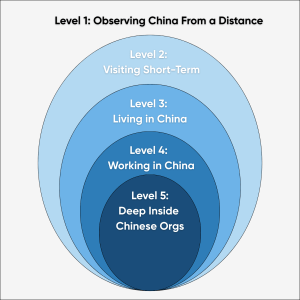
Level 1 – Viewing China from a Distance
When overseas HQs don’t visit China or have someone trusted on the ground, it can be hard to know what to believe.
While geopolitics and slanted news headlines can provide misinformation and lead to knee-jerk reactions, it is more common for differences in language, culture, and business practices to take a higher toll.
When dealing with China from a distance, overseas HQs can’t tell what information is being filtered, what consumers, partners, and clients really expect, and how best to align operations across markets.
It’s a risky proposition to be in, especially amid geopolitical uncertainty and the increasing competitiveness of local competitors.
Level 2 – Visiting Short Term
Short-term visits can be a marked improvement on having no presence in the China market, whether they be business trips, China innovation tours, or regular travel.
Not only do short visits allow overseas professionals to see China’s development up close and firsthand, but they also help false assumptions fall away.
The scale, pace, and context of China become more obvious, which is hard to grasp from overseas news headlines or social media alone. Even brief exposure is better than forming opinions entirely from a distance.
It’s also much easier to do business and build relationships with many Chinese professionals and companies face-to-face. Doors that might be closed over a Zoom call could open during a multi-week visit.
That being said, short visits don’t do all that much to further your understanding of China, or your ability to communicate effectively with Chinese professionals and companies.
It’s also common for Chinese professionals, both those who work for your China office as well as local companies, to not always be able to share the actual situation and challenges right away. A certain amount of trust and camaraderie needs to exist first.
So, short visits are certainly an improvement over handling everything online or via an agent you don’t really know. But they also can’t replace having a more solid and trusted presence in the market.
Level 3 – Living in China
Living in China long-term is a clear step up when it comes to understanding China, how Chinese people think, and the cadence and rhythm of daily life.
Daily routines replace novelty, and overseas professionals experience public spaces, services, friction, and convenience as part of normal life, rather than observing them from the outside.
This shift from observation to participation matters. When systems become part of your daily rhythm, you stop reacting to isolated moments and begin noticing patterns.
Certain behaviors stop feeling surprising. Others become more noticeable precisely because they repeat across situations, industries, and cities.
Professionals begin to internalize how decisions are made, how trust is built, and how expectations are signaled indirectly. They begin to sense when something is unsaid but understood. Context becomes intuitive rather than intellectual.
At the same time, this level still has limits. Even after years of living in China, if you are not working inside organizations, much of what is understood remains external.
You may understand consumer behavior, service expectations, and social norms, but not yet the internal pressures, tradeoffs, and incentives shaping business execution.
Even so, this stage reshapes perception in meaningful ways. It reduces overconfidence, challenges assumptions imported from overseas, and begins to narrow the gap between surface impressions and lived reality.
Level 4 – Working in China
Working in China, specifically within an organization, adds another layer of learning, as well as complexity.
At this level, it makes less of a difference whether a professional works for a Chinese company or an overseas one. After all, most employees will be Chinese, speak Chinese as their native tongue, and have their behavior shaped by Chinese culture and society.
In a professional environment, overseas talent will have the opportunity to begin understanding internal and external incentives, tradeoffs, internal pressures, and constraints. All in a Chinese cultural context.
They can also begin to see how certain overseas methods and ideas do not always fully land in the China market, and why local practices can make more sense.
And they can observe how different speeds and expectations, as well as what’s left unsaid, can lead to increasingly unaligned efforts between overseas HQs and local offices.
At this stage, it becomes much harder to assume intent equals outcome, or that global best practices automatically translate to the China market.
This leads to what matters most — overseas professionals actively looking for the right balance between global needs and local realities.
Level 5 – Deep Inside Chinese Organizations
This last level, based on my own experience in China, is the most complex. It is also more difficult to obtain proficiency in.
When overseas professionals work within Chinese-owned and managed organizations, they find that things are much more opaque and that they often have less institutional support than they would in an overseas-run environment.
First of all, it is not uncommon for most employees to only speak Chinese, and for company documents, communication platforms, and systems to be completely in the Chinese language.
To be truly able to manage across teams and understand nuance, overseas professionals will find that Chinese language skills are a requirement.
Second, while overseas employees will likely still be treated warmly inside Chinese organizations, they often will not experience the same level of deference as they might working inside an overseas company in China, especially one from their home country.
This requires the capabilities to bargain and convince colleagues and managers to accept new ideas, in an environment where the overseas approach is not the status quo.
Third, they will have to deal with internal vs. external trust dynamics, siloed organizational structures, opaque decisions from leadership, and less freedom to share their own ideas.
This requires developing the capabilities to read the room in a Chinese context, respect Face, protect internal relationships, and understand what is not being said.
Despite the difficulties, professionals with these capabilities are genuinely rare and disproportionately valuable to overseas companies navigating the China market.
They can help overseas HQs to better understand the China market, their own operations, and challenges in the country, and how to better align and execute together.
What This Means for Overseas Leaders
The most important thing overseas HQs and executives should understand is that, despite China’s increasing internationalization, their Chinese staff and partners are still operating within a Chinese cultural and organizational context. That shapes everything.
When overseas HQ teams visit China operations, they rarely get a full picture of what’s actually happening. This isn’t because Chinese teams are being evasive. It’s structural.
The cultural instinct to protect relationships, avoid escalating problems prematurely, and present things smoothly to visiting leadership means that candid feedback rarely travels upward naturally, even in offices run by overseas professionals.
The same applies in reverse. When Chinese companies partner with overseas organizations, adapting to overseas operational expectations doesn’t happen automatically, regardless of how much both sides want the partnership to work.
This is where someone with deep on-the-ground experience, but who can also step back and communicate clearly to overseas leadership, becomes genuinely valuable. Not just someone embedded in China, but someone who understands both sides of the gap well enough to close it.
That gap is almost always wider than overseas HQs realize. And closing it starts with knowing it exists.
If you’re interested in thoughtful perspectives on China, cross-border work, and how culture, incentives, and organizations shape real outcomes, you’re welcome to subscribe to China Culture Corner and receive future posts by email.
I also share related ideas and longer-form video commentary on LinkedIn and YouTube, and post updates across the channels linked above.
If you or your organization is navigating China execution or cross-border alignment challenges, I work with teams on an embedded and remote basis. Reach out directly: Sean@SageSightConsulting.com


Level 4 to 5; the big jump. You’ve got that one covered and where your consulting “blue ocean” is. 👍🏼
Peter
Peter Hill International
Executive Coaching | Decision Clarity in Global Markets
Discreet 1-1 Advisory for C-Suite and Founders
Mobile: +1 808.384.9461
Web: http://www.flowwithpeter.com
LikeLike
Thanks Peter.
After co-hosting a workshop for visiting execs in China, I’ve come up with a new way to describe the difference between level 4 and level 5. When you are inside a Chinese org as a non-Chinese, you have to operate according to their operating logic. It requires a higher level of adaption.
Overseas offices/companies in China, even when their staff are mainly Chinese, still have the overseas logic baked into their operations to a degree.
LikeLike