One story that has been dominating Western news networks for more than a month is the mystery of the missing Malaysian Airlines flight MH370.
As of this article’s publishing, the search to find the missing plane and passengers in the South Indian Ocean is still ongoing, with no definite news on the location of the plane or the fate of the passengers.
From the very beginning, the story has had a specific Chinese angle, as 153 of the 239 passengers aboard flight MH were from Mainland China. Many of the family members of these Chinese passengers have been forced to wait for weeks, some in Malaysia and some in China, hoping for some word on their loved ones.
And while Western viewers have been privy to the mourning and public outbursts of these Chinese families, there has been little coverage in the West on the specific reasons behind them.
While it is certainly true that any family in this situation would be wracked with grief, some specific differences in the grief displayed by these Chinese families reflect cultural and social disparities between China and Western countries. In the following article, some of these differences will be explored to enlighten Westerners on the true plight of these Chinese families.
Families in China Don’t Get a Second Chance
The family has always been very important in China, though the smaller size of the modern Chinese family has in some ways increased its importance, and perhaps its fragility.
While the Chinese family (including the extended family) has traditionally been very large, its size has been drastically reduced due to the one-child policy. And while there may be no technical barriers to rebuilding a family after a tragedy, it still may be a practical impossibility. On one hand, the Chinese possess strong prejudices against divorce and remarriage, with a stable family viewed as more important than individual happiness.
While a Chinese man or woman who has lost their spouse may desire to find another partner, there may be internal resistance from friends and family. Many Chinese are strongly against marrying at a later age. And while Chinese men find it possible to marry a younger woman (if they have enough money), Chinese women above the age 30 or 35 will likely find it near impossible.
On the other hand, even though the birth of a second child is allowed under the Chinese one-child policy after the death of the first child, Chinese couples are rarely willing to have children at a later date. This is partly due to the increasing risk of birth defects as a woman ages (even though plenty of later births occur in other countries), as well as the continuing belief that a woman’s role is to marry and have children early.
For the above reasons, Chinese families who have lost one or more members of their families in the MH370 tragedy may be faced with the inescapable fact that they will have no chance to rebuild or recover.
The Public Outpouring of Grief
One issue that struck a chord with this author was the grief displayed very publicly by some Chinese family members. While any family faced with such a horrific tragedy would surely be filled with grief, the ways the Chinese (and many Asians in general) deal with their grief and negative emotions differ significantly from those in the West.
Many Westerners hold the view that the Chinese are more reserved in their displays of emotion, and to a degree, they are correct. Chinese society’s early focus on hierarchy and collectivism meant that everyone had a proper place and way to act. One of the ways this translates into modern Chinese society is a reticence to discuss or openly display emotion among strangers and sometimes even one’s own family.
However, there are several reasons why Chinese people might break with this norm where grief and mourning are concerned.
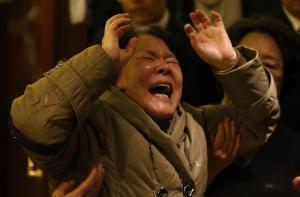
The Chinese concept of Ren (忍) can be involved in sudden and violent displays of emotion. In Chinese, Ren means to endure or to tolerate.
Because specific members of Chinese society have specific roles and accepted behavior within those roles, they are rarely completely free to act or speak their mind.
As such, it is very common for negative feelings and stress to gradually increase within a Chinese person due to emotional pressure. At particularly tumultuous times, these negative emotions can become too much to bear, and like a broken dam, spill forth in a torrent.
Also, under certain circumstances, especially where the death of loved ones and close friends is involved, Chinese people are expected to display exaggerated emotions.
This practice comes from the Chinese custom of worshiping their ancestors and revering their elders, an incredibly important part of traditional Chinese life. The eldest member of the family (usually the eldest male) was always accorded the most respect, and upon dying, an elaborate ceremony would be held to pay respects and allow the family to mourn.
This mourning would many times be public in front of the neighborhood. Chinese family members who were not seen to mourn and grieve publicly and exaggeratedly were thought to be heartless and not filial (not fulfilling their duty to their elders).
In modern China, where family sizes are much smaller, this type of behavior may be extended to other family members besides the oldest, such as a child or sibling.
Offense Is the Best Defense in Modern Chinese Society
Many family members of the Chinese passengers of flight MH370, in addition to their grief, have been notably aggressive and confrontational in both their language and actions toward representatives of Malaysian Airlines and the Malaysian government.
While this might be understandable for anyone with a missing loved one, it is more so for the Chinese. The rapid pace of China’s economic development, along with the weak social and legal infrastructure present in many areas in China, has resulted in China’s citizens becoming accustomed to being taken advantage of with little to no legal recourse.
As such, the Chinese often take an aggressive stance when faced with a situation in which they feel they are being taken advantage of. This author has personally observed this aspect of modern Chinese society on multiple occasions and offers the following examples to further illustrate this point.
Supermarket Lines: A common sight at China’s large Hypermarts (e.g., Carrefour, Walmart) is one or several customers haranguing and hectoring cashiers over pricing or other issues of discontent. More often than not, excuses are not accepted, and the customer will keep at it until their concern is adequately addressed.
Delays at the Airport: In one instance, when flying from Shanghai to the USA, this author’s flight was canceled, and all passengers were shuttled off to another airport to catch a different flight. Little information was provided to any of the passengers as to whether it was feasible to make the arranged flight.
Due to what was viewed as a lack of information and poor customer service, several Chinese passengers came close to assaulting the accompanying airport representative when their questions were not answered satisfactorily. In the end, these passengers detained this representative aboard the shuttle bus for 5-10 minutes before he was finally allowed to leave.
The important point to be aware of from the preceding examples is not that the Chinese are mean or violent; indeed, far from it. In modern China, the pace of economic growth, along with weak social and legal infrastructure have created a social environment in which many Chinese are very wary about trusting companies or their fellow citizens.
One result of this is that the Chinese can be understandably aggressive in defending their own interests, especially because, in many cases, the law may not be able to.
Returning to the tragedy of missing flight MH370, it seems to be the opinion of many, if not all, of these Chinese families that Malaysian Airlines and the government have, at the very least, bungled the investigation and search efforts, and may very well have withheld information from the public in their own self-interest.
My own interpretation of the protests, aggressive rhetoric, and demands put forth by these families is that they have become convinced that the Malaysian government and Malaysian Airlines have no intention of going out of their way for the families and that the only option available is to fight back and become loud enough to force compliance with their demands and concerns.
What Does This Mean For Western Audiences?
To a certain extent, the Chinese are just like people all over the world. They all have families and react similarly as anyone else when they lose someone they love.
However, one key point that should be remembered is that although the Chinese may appear similar to Westerners on the surface in some ways, they are actually very different. The Chinese mindset is distinct and is shaped not only by their cultural history, but by the conditions of modern Chinese society.
Understanding Chinese culture and society will not only provide Westerners with a greater appreciation of the Chinese people but will also make it easier to empathize with them when tragedies similar to the missing flight MH370 occur in the future.
If you’re interested in thoughtful perspectives on China, cross-border work, and how culture, incentives, and organizations shape real outcomes, you’re welcome to subscribe to China Culture Corner and receive future posts by email.
I also share related ideas and longer-form video commentary on LinkedIn and YouTube, and post updates across the channels linked above.
If you or your organization is navigating China execution or cross-border alignment challenges, I work with teams on an embedded and remote basis. Reach out directly: Sean@SageSightConsulting.com