
Category Archives: WORK IN CHINA

Your “China Problem” Isn’t Culture. It’s Operations.

Recently, I sat down with a group of global executives visiting Shenzhen. They wanted to understand China Speed. I told them that was the wrong question. The real question wasn’t what China Speed is. It was why it exists, and what it means for how their own organization needs to operate.

That conversation reflects how most overseas businesses approach China. They focus on big concepts like culture, China Speed, and the Chinese way of doing things. And they frame the gap as something to study or overcome, not something to operate inside.

But framing it that way turns a practical business problem into something that feels permanently out of reach.

The Misdiagnosis: Culture Can’t Be Solved

Framing China business challenges purely in terms of culture turns what should be practical business problems into near-insurmountable dead ends. Here are a few examples:

Culture is too opaque: Chinese culture consists of thousands of years of history. Even locals and experts don’t know it all. There’s no time for businesses to learn everything in ways that meaningfully impact short-term business timelines.

Culture is too foreign: Chinese business culture often feels like the complete opposite of how overseas businesses feel comfortable operating, and it’s often framed as either the right way or the wrong way. It’s therefore no surprise that many overseas businesses have alternated between pushing a “global” playbook in the Chinese market or handing everything over to local teams and hoping for the best.

Culture is too personal: Culture doesn’t sound like anything that can be part of a global or local business strategy. It’s therefore not surprising to see the “Chinese Business Culture Problem” pawned off on individual business leaders or managers. And learning about Chinese culture online is no way to solve business problems in the here and now.

So if “culture” isn’t the answer to solving China’s business challenges, what is?

The starting point is understanding that Chinese companies aren’t doing things differently because of who they are. They’re doing things differently because of the environment they’re operating in, and their choices are rational.

The Reframe: It’s Operational Logic

During the conversation with the overseas executives in Shenzhen, I reframed the culture argument this way: “Chinese companies don’t move fast because of their culture. They move fast because their competitive environment exerts specific pressures, which force Chinese companies to make specific, rational operational choices to compete and survive.”

That’s not to say that culture plays no role. The difference is that culture helps to understand China, but it does not help drive shorter-term business decisions.

Chinese companies, teams, and professionals usually have very logical reasons for acting the way they do, whether it be the most practical way to make money, staving off competitors, maintaining internal unity or teamwork, or protecting one’s career.

Here’s how I’ve seen the Chinese operational logic play out:

CEOs pivot fast and kill what isn’t working. I’ve seen Chinese CEOs pivot carefully planned marketing campaigns in less than two days when a competitor moved early. There was no discussion, no alignment meeting, no cross-functional sign-off. From the outside that looks chaotic. From the inside, it was completely rational: The window was closing, and waiting for consensus would have meant missing it entirely.

Companies run parallel teams deliberately. I’ve seen Chinese tech companies use parallel teams not just to move faster, but to raise internal standards. Two teams working simultaneously on the same problem, both knowing the other exists. No announcement, no explanation. A second team simply appeared. Everyone understood what it meant. The standard had been raised without a single difficult conversation.

Even small businesses operate this way. And I’ve seen a single-person gelato shop in Shenzhen create over 200 flavors in two years (roughly two new flavors every week) specifically designed for the local palate. Not as a marketing strategy. As a direct response to a consumer standing in front of her asking what’s new. If one person with no budget operates this way, consider what a well-resourced local competitor can do at scale.

All of these actions look and feel strange or wrong from the outside. But they make sense on the inside. Viewing them as culture doesn’t help overseas companies change or adapt. Viewing them as rational operational choices within the Chinese context does.

The Complication: Adaptation Has a Ceiling

Culture can’t be changed or adapted to. Not really. And not by organizations. Many global organizations may have China teams made up of highly-skilled Chinese professionals. But they’re still reporting to overseas HQs that use overseas logic and cultural norms. And while they are Chinese, they are still operating within a foreign system.

Overseas companies also have more considerations, stakeholders, and rules than many of their Chinese competitors do. They have to consider how their actions may be perceived by people across many countries and cultures. Many local competitors just have to think about one.

That’s one reason why “just follow local culture” or “let a local China team or partner handle everything” rarely works out. If you completely separate a local China operation or partner from your own business logic and needs, they’ll only make decisions about what makes sense in a purely Chinese context, without regard to how it might affect your global business.

A core question overseas business leaders should ask is: Are you actually trying to fix operational challenges for China, or simply push the adoption of global operational methods in China? One helps you operate effectively in China. The other is pushing a system that makes you feel comfortable but may not work in the local context.

The question isn’t how to copy the model. It’s understanding the operational logic well enough to find what actually works within your constraints.

The Implication for Western Leaders

The signals on the ground are usually already there. Local Chinese team members will already know what is going wrong. And local partners will already understand how the competitive landscape works.

The challenge is when those signals can’t be heard. I remember an agency pitch from several years ago, where my team briefed an overseas executive based in China on new local shopping trends and how they were changing retail in China.

His response? “That’s not the way we do things here.”

When operational signals and local needs are coming through loud and clear, but overseas businesses are either unable to hear them or unwilling to act on them, the culture framing just becomes another reason to dismiss what the market is already telling you.

The question isn’t whether your China team or partner understands the market. It’s whether your organization is designed to listen to them


If you’re interested in thoughtful perspectives on China, cross-border work, and how culture, incentives, and organizations shape real outcomes, you’re welcome to subscribe to China Culture Corner and receive future posts by email.

I also share related ideas and longer-form video commentary on LinkedIn and YouTube, and post updates across the channels linked above.

If you or your organization is navigating China execution or cross-border alignment challenges, I work with teams on an embedded and remote basis. Reach out directly: Sean@SageSightConsulting.com

What ‘On the Ground in China’ Actually Means, and Why It Matters

Many cross-border business professionals emphasize being “on the ground” in China, but what does this term mean, and how does it really help overseas companies in the China market?

After all, an overseas tourist or student in Shanghai is technically on the ground in China. So is an overseas professional who speaks the local language and has been working in the country for 30 years.

The key is understanding the degrees in between, and how different types of on-the-ground experience provide different benefits to overseas companies in the China market.

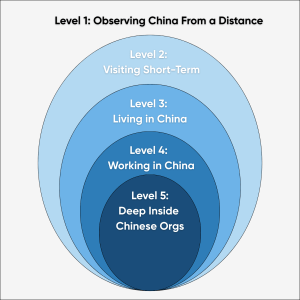
Based on my own 15 years of experience operating in China, I’ve mapped out five distinct levels of being ‘on the ground.’ In the following sections, I’ll break down what each level provides and where its limitations lie.

Level 1 – Viewing China from a Distance

When overseas HQs don’t visit China or have someone trusted on the ground, it can be hard to know what to believe.

While geopolitics and slanted news headlines can provide misinformation and lead to knee-jerk reactions, it is more common for differences in language, culture, and business practices to take a higher toll.

When dealing with China from a distance, overseas HQs can’t tell what information is being filtered, what consumers, partners, and clients really expect, and how best to align operations across markets.

It’s a risky proposition to be in, especially amid geopolitical uncertainty and the increasing competitiveness of local competitors.

Level 2 – Visiting Short Term

Short-term visits can be a marked improvement on having no presence in the China market, whether they be business trips, China innovation tours, or regular travel.

Not only do short visits allow overseas professionals to see China’s development up close and firsthand, but they also help false assumptions fall away.

The scale, pace, and context of China become more obvious, which is hard to grasp from overseas news headlines or social media alone. Even brief exposure is better than forming opinions entirely from a distance.

It’s also much easier to do business and build relationships with many Chinese professionals and companies face-to-face. Doors that might be closed over a Zoom call could open during a multi-week visit.

That being said, short visits don’t do all that much to further your understanding of China, or your ability to communicate effectively with Chinese professionals and companies.

It’s also common for Chinese professionals, both those who work for your China office as well as local companies, to not always be able to share the actual situation and challenges right away. A certain amount of trust and camaraderie needs to exist first.

So, short visits are certainly an improvement over handling everything online or via an agent you don’t really know. But they also can’t replace having a more solid and trusted presence in the market.

Level 3 – Living in China

Living in China long-term is a clear step up when it comes to understanding China, how Chinese people think, and the cadence and rhythm of daily life.

Daily routines replace novelty, and overseas professionals experience public spaces, services, friction, and convenience as part of normal life, rather than observing them from the outside.

This shift from observation to participation matters. When systems become part of your daily rhythm, you stop reacting to isolated moments and begin noticing patterns.

Certain behaviors stop feeling surprising. Others become more noticeable precisely because they repeat across situations, industries, and cities.

Professionals begin to internalize how decisions are made, how trust is built, and how expectations are signaled indirectly. They begin to sense when something is unsaid but understood. Context becomes intuitive rather than intellectual.

At the same time, this level still has limits. Even after years of living in China, if you are not working inside organizations, much of what is understood remains external.

You may understand consumer behavior, service expectations, and social norms, but not yet the internal pressures, tradeoffs, and incentives shaping business execution.

Even so, this stage reshapes perception in meaningful ways. It reduces overconfidence, challenges assumptions imported from overseas, and begins to narrow the gap between surface impressions and lived reality.

Level 4 – Working in China

Working in China, specifically within an organization, adds another layer of learning, as well as complexity.

At this level, it makes less of a difference whether a professional works for a Chinese company or an overseas one. After all, most employees will be Chinese, speak Chinese as their native tongue, and have their behavior shaped by Chinese culture and society.

In a professional environment, overseas talent will have the opportunity to begin understanding internal and external incentives, tradeoffs, internal pressures, and constraints. All in a Chinese cultural context.

They can also begin to see how certain overseas methods and ideas do not always fully land in the China market, and why local practices can make more sense.

And they can observe how different speeds and expectations, as well as what’s left unsaid, can lead to increasingly unaligned efforts between overseas HQs and local offices.

At this stage, it becomes much harder to assume intent equals outcome, or that global best practices automatically translate to the China market.

This leads to what matters most — overseas professionals actively looking for the right balance between global needs and local realities.

Level 5 – Deep Inside Chinese Organizations

This last level, based on my own experience in China, is the most complex. It is also more difficult to obtain proficiency in.

When overseas professionals work within Chinese-owned and managed organizations, they find that things are much more opaque and that they often have less institutional support than they would in an overseas-run environment.

First of all, it is not uncommon for most employees to only speak Chinese, and for company documents, communication platforms, and systems to be completely in the Chinese language.

To be truly able to manage across teams and understand nuance, overseas professionals will find that Chinese language skills are a requirement.

Second, while overseas employees will likely still be treated warmly inside Chinese organizations, they often will not experience the same level of deference as they might working inside an overseas company in China, especially one from their home country.

This requires the capabilities to bargain and convince colleagues and managers to accept new ideas, in an environment where the overseas approach is not the status quo.

Third, they will have to deal with internal vs. external trust dynamics, siloed organizational structures, opaque decisions from leadership, and less freedom to share their own ideas.

This requires developing the capabilities to read the room in a Chinese context, respect Face, protect internal relationships, and understand what is not being said.

Despite the difficulties, professionals with these capabilities are genuinely rare and disproportionately valuable to overseas companies navigating the China market.

They can help overseas HQs to better understand the China market, their own operations, and challenges in the country, and how to better align and execute together.

What This Means for Overseas Leaders

The most important thing overseas HQs and executives should understand is that, despite China’s increasing internationalization, their Chinese staff and partners are still operating within a Chinese cultural and organizational context. That shapes everything.

When overseas HQ teams visit China operations, they rarely get a full picture of what’s actually happening. This isn’t because Chinese teams are being evasive. It’s structural.

The cultural instinct to protect relationships, avoid escalating problems prematurely, and present things smoothly to visiting leadership means that candid feedback rarely travels upward naturally, even in offices run by overseas professionals.

The same applies in reverse. When Chinese companies partner with overseas organizations, adapting to overseas operational expectations doesn’t happen automatically, regardless of how much both sides want the partnership to work.

This is where someone with deep on-the-ground experience, but who can also step back and communicate clearly to overseas leadership, becomes genuinely valuable. Not just someone embedded in China, but someone who understands both sides of the gap well enough to close it.

That gap is almost always wider than overseas HQs realize. And closing it starts with knowing it exists.


If you’re interested in thoughtful perspectives on China, cross-border work, and how culture, incentives, and organizations shape real outcomes, you’re welcome to subscribe to China Culture Corner and receive future posts by email.

I also share related ideas and longer-form video commentary on LinkedIn and YouTube, and post updates across the channels linked above.

If you or your organization is navigating China execution or cross-border alignment challenges, I work with teams on an embedded and remote basis. Reach out directly: Sean@SageSightConsulting.com

Hiring for China in 2026: A Reality-Based Checklist `

As we move into 2026, China remains a difficult market for many overseas brands, and this trend looks set to continue in the new year.

On one hand, overseas and especially Western brands are coming face-to-face with a decline of their global brand capital. What once was an easy sell (global brands = savvy and trustworthy) is much harder as Chinese consumers become more discerning and demanding.

On the other hand, more Chinese competitors are entering the market, not simply offering high-quality products at an affordable price. They are also much closer to Chinese consumer mindsets and trends, and can pivot faster, and more effectively in some cases, than overseas competitors.

It’s also worth noting that in response to these pressures, many overseas firms that largely made the switch from expatriate placements to local managers and leaders have not always seen this type of direct hiring localization strategy bear fruit.

I do not subscribe to the arguments in certain overseas business circles that the Chinese market is simply “too hard“ and there’s no way to win. I believe there are indeed different approaches to success, but I feel that in 2026, the answer is global talent. By global talent, I mean people who can operate inside China’s pace and realities while still aligning with overseas HQ expectations.

Global talent (foreign or Chinese), as introduced in the short video below, focuses on talent, managers, and leaders who can live and operate in both Chinese and overseas business and social contexts. It doesn’t mean that you shouldn’t hire locals in China (you definitely should), but too many problems result from insisting on a China-only or HQ-only approach.

Personal Note: I am not a recruiter. These insights come from my many years of working in China, seeing how cultural misunderstadnings impact businesss outcomes and how the right hiring choices are vital to aligning overseas HQ expectations and China market realities.

The checklist below reflects global talent as a third hiring path for overseas HQs looking to hire talent and consultants in China in 2026 and beyond. Some items on the checklist focus more on what to consider before hiring foreign nationals, but many can also be applied to Chinese nationals, too.

After all, nationality isn’t a good hiring strategy. When recruiting key leaders and bridge-builders to connect with the China market, it shouldn’t matter where they’re from. Actual skills, experience, and cross-cultural capabilities are what really make the difference.

Talent That is Already In-Country

First and foremost, unless it can’t be avoided, it’s always best to hire someone who is already based in China, for several reasons.

The most practical reason is due to how long the visa and onboarding process can take. Add that to the longer HQ hiring process, closing out current roles, and relocation, and your local competitors could have easily launched a new product (or more) before you got your new leader on the ground in China.

This is something I’ve seen multiple times throughout my own career when acting as a hiring manager at Chinese tech firms. In an ideal scenario, I might consider bringing in a strong foreign candidate, even one with a background working in China. However, I usually declined overseas hires due to how long it would take and the potential negative impact on ongoing projects.

Another related factor is that someone based in and working in China is much more likely to be in tune with Chinese business culture and society. Aside from language fluency and cultural knowledge, China changes so quickly that being away for a few years can easily put one at a disadvantage.

Talent That Speaks Chinese (Mandarin)

Language is a key requirement I often raise for global talent that will bridge the gap between China and global HQs. While it’s natural to assume that local Chinese talent should be able to communicate in English or the HQ language, it’s just as important for foreign hires and consultants in China to possess solid skills in Chinese.

Think of a game of telephone, where the message gets more garbled and more distorted the more middlemen it goes through. And in China, it’s not just about communication meaning drift, it’s also about how stakeholders protect their own interests.

Local suppliers and partners speak indirectly, or even say yes when no is perceived as inconvenient. Translators and interpreters soften their meaning to avoid perceived insults and protect harmony. Local employees might protect their own interests or only tell their boss or the HQ what they think they want to hear. This muddies the water and prevents the overseas HQ from forming a clear picture and making informed decisions.

This is not about assigning blame, but rather helping overseas HQs and leaders understand the practical realities of language and translation in the China market. By ensuring your bridge between the HQ and China not only speaks Chinese fluently but is also willing to give you the plain truth/translation, you can avoid many more troubles down the road.

Talent That Has Worked Inside Chinese Companies

One of the most overlooked advantages for foreign companies in China is hiring talent (especially foreign talent) that has worked inside Chinese companies.

Foreign companies might initially think it strange to hear that they might want to work with someone who has worked inside Chinese companies. After all, they aren’t Chinese. Shouldn’t they hire someone with experience in foreign companies in China? But this isn’t about familiarity or ideology, it’s about ensuring your key hires understand China’s operating logic.

For foreign businesses in China, most, if not all, of the key competitors will be Chinese. It’s useful to have someone with insight on how competitors operate, which areas can be improved, and who can communicate this clearly to the overseas HQ.

Foreign HQs have no issues operating like a foreign business, but they could very well have potential issues operating like a Chinese one in the domestic China market. Talent with past experience in Chinese competitors can bring many benefits and advantages to foreign firms in China, assuming they are willing and able to make the adjustment to working in a foreign organization and reporting to an overseas HQ.

Talent That Understands Chinese Business Culture

A deeper understanding of Chinese business culture is necessary to manage operations between local Chinese teams and overseas HQs. And they take years to learn and can’t simply be picked up on the job.

Things like making decisions with incomplete information, comfort with ambiguity and rapid pivots, and understanding when rules are flexible versus non-negotiable.

First of all, the speed the Chinese market operates is no joke. Chinese companies simply move faster, with planning cycles measured in days or weeks, not quarters. Companies change direction quickly without formal processes, and teams expect managers to decide, not deliberate. Overseas managers who are not familiar with this operating speed often default to overseas control mechanisms like approval gates, reporting layers, or alignment meetings. But this just slows teams down and erodes local trust.

Second, understanding how to manage local Chinese teams is vital. In many Chinese teams, authority comes from clarity and decisiveness, not from building a consensus. Teams expect direction, not facilitation. Chinese team members rarely give direct feedback, but their dissatisfaction will still lead to negative business results. Overseas managers who don’t understand these intricacies may see their Chinese team members’ work quality drop, or see them leave for Chinese competitors that offer better cultural alignment, as well as better compensation.

Lastly, understanding how to manage relationships with local suppliers and partners is vital. Global talent in China is needed that can help the overseas HQ to prioritize long-term cooperation over transactional contracts, accept frequent renegotiation as conditions change, and undertake relationship management outside of formal meetings.

Talent That Has Experience Outside Expat Centers (e.g., Shanghai)

On LinkedIn and in WeChat groups, I see constant updates from foreigners moving to Shanghai and looking for work there. From one viewpoint, Shanghai is a great opportunity for foreign talent. But the point I would like to raise here is that talent, especially foreign talent that has only worked in Shanghai and other top-tier cities, presents a real risk to foreign companies in the China market – it’s simply too safe.

In China, a common phrase is to “eat bitterness” (吃苦; chī kǔ), which refers to one’s ability to bear hardships. To succeed in China, and to help foreign companies succeed, talent and leaders need to be able to move fast, get things done, and deal with enormous pressures. And it’s a real possibility that the Shanghai and other first-tier city environments might not provide the necessary foundation.

Shanghai is the only city in China where English can come close to functioning as a real working language; the city is much more international, and there is much more legacy expat infrastructure. This means there is much less need or incentive for foreign talent to adapt to the realities that rule the rest of China.

For foreign companies struggling and/or looking to improve in the China market, foreign (or any) talent with Shanghai-only experience should be a red flag, especially if they can’t check off other important items on this list. The China market is difficult, and foreign companies in China need someone who can rise to the challenge.

Talent That Will Challenge Your Assumptions

Lastly, one thing that foreign HQs really need is someone who will not simply make them feel comfortable, will avoid conflicts, and simply focus on getting their paychecks during their tenure.

And to be honest, I’ve seen this happen with both foreign and Chinese talent and leaders. If foreign HQs want to understand why their businesses are not doing better in the Chinese market, they should focus on global talent and leaders who will call out issues and work to make improvements.

But at the same time, even the best talent and leaders will find it hard to drive change if overseas HQs do not provide the required support or pursue needed changes on their own end. After all, in China you need to move fast, and moving fast often requires the overseas HQ to move faster too.

Closing Thoughts

Overseas brands are now facing challenges in China that in some ways mirror those encountered by Chinese companies expanding overseas. Both are discovering that the same old approach to talent isn’t working.

First, both tried sending their own people to the new market or managing things from their HQ. Then, after a more local approach was tried, it was found in many cases to create too large a disconnect between HQ expectations and local execution.

This article aims to present a new path, framed in terms of mutual understanding, support, and alignment. The above checklist is in no way meant to substitute for professional and functional qualifications, nor personal fit for specific leadership roles.

That being said, in light of the complexities of connecting and aligning teams in China and overseas HQs, especially in an area of ever-increasing competitiveness from domestic Chinese companies, the old way is no longer working.

Companies that hope to survive and thrive in the increasingly competitive China market need a new approach to talent – not expat talent, not local talent, but global talent – to connect them to China.


If you’re interested in thoughtful perspectives on China, cross-border work, and how culture, incentives, and organizations shape real outcomes, you’re welcome to subscribe to China Culture Corner and receive future posts by email.

I also share related ideas and longer-form video commentary on LinkedIn and YouTube, and post updates across the channels linked above.

If you or your organization is navigating China execution or cross-border alignment challenges, I work with teams on an embedded and remote basis. Reach out directly: Sean@SageSightConsulting.com