Category Archives: WORK IN CHINA

Articles focused on the realities of working in Chinese organizations, including management styles, workplace culture, and cross-cultural challenges. Emphasis is placed on understanding systems, not judging individuals.

Why Cross-Border Leadership in China Requires Dual-Culture Management

Editor’s note (2026):
This article was originally written in 2020. While the examples reflect that period, the leadership challenges around trust, speed, and cross-border alignment remain highly relevant. I’ve lightly updated it to reflect my current perspective.

Managing cross-border teams and projects can be difficult. Different languages and customs create daily challenges, and frustrations often appear where you least expect them. This kind of cultural friction is a natural part of adapting to any new environment, and with time and effort, things often improve.

However, terms like cultural friction are often relegated to purely personal experiences. The following article will discuss how culture influences organizational thinking and behavior, and how expatriate and foreign managers must adapt.

The management challenge becomes even more complex when working with large cultural gaps and being expected to balance HQ and local team needs while delivering business results.

Whether you are part of a team or leading a department or office, success depends on more than personal adjustment. It depends on how well you manage within a specific business culture, as well as how effectively an overseas HQ can provide support, where many norms and expectations are often left unspoken.

China is a country and market where these types of issues become unavoidable. Management is often more indirect, and context, relationships, and hierarchy play an important role in how work actually gets done.

Beyond internal dynamics, leaders must also understand local consumers, business partners, media, and government stakeholders. Many decisions leaders are expected to make are shaped by our prior experiences in our home markets, which form an internal map of what we believe works and what does not.

While these mental patterns are useful, they can also limit us and blind us to other possibilities when operating in new environments. But they can also be limiting. This can slowly undermine local trust and decision-making and, over time, lead to business failure.

This is where traditional cross-cultural thinking runs into setbacks. The Chinese market is not simply a culture; it is a complex system of doing business. It is also constantly changing with the breakneck development of a country, which is fragmented by region along different cultural and industrial lines.

What is Dual-Culture Management?

With this in mind, I want to introduce a concept I’ve discussed with students and professionals in Mainland China: Dual-Culture Management (双文化管理).

While it may sound similar to cross-cultural management, there are several important distinctions. First, the idea of Dual-Culture Management focuses on the ability to observe and respect multiple cultural systems at the same time, rather than expecting one to dominate the other.

In my work in China, I have often seen cross-cultural collaboration simplified into the culture with less power becoming subservient to the culture with more power.

This can materialize in the form of Chinese teams in Western companies being forced to adopt Western styles, or Western employees in Chinese companies being expected to conform completely to local norms. In both cases, the result is usually surface-level compliance rather than genuine alignment.

In addition to purely cultural ideas, there are also business practices and market realities. In China, we see traditional culture influencing how business is done, but we also see enormous impact from technological innovation, modern consumer preferences, as well as concentrated industrial hubs.

I began using the term “dual-culture” because bridging cultures effectively requires more than switching between styles. It requires the ability to hold multiple ways of thinking at once. Here, success is not only about meeting business objectives, but about building strong, sustainable, and trusted teams across markets.

To move toward this more balanced approach, there are several areas where I suggest leaders and managers consider making adjustments: communication style, business instincts, cultural sensitivity, and working speed.

Adjusting Your Management and Communication Style

Taking on a management role in a foreign business environment can be challenging. Differences in hierarchy, organizational structure, and workplace culture often shape how teams expect to be led.

For example, when overseas managers move to China, they may find that teams require more direct instruction. This can sometimes lead to misunderstandings stemming from norms in overseas markets. perceptions of micromanagement or the need for additional training around tasks that might be considered basic in other markets.

Communication itself can also be a challenge, especially when English is a second or third language for most of the team. In these situations, the need for clearer direction often exists alongside the expectation of more respectful and indirect communication, regardless of whether someone is a manager or an employee.

In China, there are also long-standing cultural concepts related to management and behavior, including ideas around face, relationship-building, and appropriate conduct. I’ve discussed some of these previously, including the concept of Suzhi, which touches on expectations around character, etiquette, and social behavior.

While every company is different, these factors help illustrate why management practices that work well elsewhere may need to be adapted in the Chinese context.

From my experience, most Chinese colleagues do not expect foreign managers to adapt perfectly. However, those who make the effort to adjust often see greater success in daily communication, team management, and relationship-building over time.

In the end, Chinese professionals and teams want to feel respected by their boss, organization, and even the overseas HQ. They just want to do it in their own, familiar way.

Adjusting Your Business Instincts

When Western companies establish operations in markets such as China, one of the biggest challenges for managers on the ground and leadership overseeing operations from abroad is how familiar business instincts can quietly steer decisions in the wrong direction.

If you want to hit your business targets, you need to understand local market realities. And the realities in China are fundamentally different, from how consumers buy to how companies operate and how the government views risk.

Senior leaders often rely heavily on their previous experience and an unconscious sense of how things “should work.” In China, these instincts can affect decisions across many areas, including people management, partnerships, media engagement, and interactions with government stakeholders.

A Chinese client told me, “we want to work with you because you understand how Huawei does things.” My Western boss told me, “the Huawei way is wrong.”

One common example is local media relations. In many Western markets, media engagement centers on relationships and expectations of editorial independence. In China, media dynamics are shaped by different commercial arrangements, government influence, and regulatory considerations. For overseas companies, this creates both operational challenges and potential risks if these differences are misunderstood.

Another example comes from my own experience. While advising a Western company planning to expand in China, my team presented insights into new retail models that were already working in the local market. The primary feedback from senior leadership was that these approaches did not fit their existing operating model.

This reluctance to consider alternative approaches is not unusual. However, in China, where domestic competitors understand the market deeply and move quickly, this type of mindset can make it very difficult to compete effectively.

Overall, continuing with “business as usual” in a new market is a common instinct. At best, it leads to poor preparation. At worst, it results in serious market mistakes. Leaders expanding into China need to be willing to recalibrate their instincts if they want to succeed alongside local competitors.

Adjusting Your Cultural Sensitivity

Every market contains cultural landmines, but in China, these can be amplified by the speed and scale of digital communication.

One well-known example was when Dolce & Gabbana faced widespread backlash for releasing advertising content in China that many consumers perceived as racist. The situation escalated quickly, leading to the cancellation of events and a widespread refusal by e-commerce platforms to carry the brand.

Another example comes from IKEA in Shanghai. Over time, some of its stores became popular gathering places for elderly residents. When the company attempted to change this practice by forcing older visitors to leave, the backlash on social media was swift and damaging.

These examples highlight how everyday operational decisions can take on very different meanings when viewed through a local cultural lens.

Foreign companies and senior managers must not only adjust how they think about consumers, but also build habits of including local managers and talent in decision-making processes. Doing so helps surface potential issues early and reduces the risk of costly mistakes.

Adjusting Your Operating Speed

Different cultures operate at different speeds. Many people are familiar with examples such as the so-called “Mañana Culture” in parts of Latin America, where work often moves at a slower pace.

China presents a much different challenge.

In the Chinese tech sector in particular, long working hours and intense workloads are common. Employees, especially engineers, are often expected to handle multiple projects simultaneously. Tight schedules, late meetings, and frequent travel are not unusual.

From my own experience working inside companies like Huawei, these conditions reflect the competitive pressure companies face in the Chinese domestic market. They also tie closely to incentive structures, where compensation and career advancement are strongly linked to performance and results.

Many Chinese employees are highly driven, both by personal ambition and by pride in seeing domestic companies compete successfully on the global stage. As a result, speed becomes deeply embedded in how organizations operate.

This “China Speed” phenomenon, which I often discuss on LinkedIn, is a combination of national-level planning, regional infrastructure hubs, and ingrained company behavior. And it can be difficult for overseas leaders and HQ teams to adapt to. Processes may feel unclear, structures informal, and expectations constantly shifting.

However, as can be seen from China’s massive technical advancements in areas like AI, robotics, new energy, and other sectors, China Speed is a huge advantage for Chinese companies, and a huge risk for overseas companies.

For overseas leaders operating in this environment, there is a clear challenge in learning to move faster to compete locally while maintaining alignment and trust with overseas HQ teams.

Closing Thoughts

In recent years, with the rise of domestic competitors, the Chinese market has become more difficult for overseas firms. Likewise, Chinese companies looking at overseas expansion are being met with rising geopolitical risks and consumer expectations.

Dual Culture Management can act as a helpful tool in reframing how we understand, interact with, and build relationships with stakeholders in different cultures, markets, and organizations.

Success does not come automatically or quickly. Frustration and discomfort are natural, especially early on. Progress requires the willingness to move forward while also accepting that other systems, values, and practices that differ from your own are not fundamentally wrong.

To learn more about the intricacies of navigating, communicating, and managing across China and overseas markets, feel free to connect with me on LinkedIn.


If you’re interested in thoughtful perspectives on China, cross-border work, and how culture, incentives, and organizations shape real outcomes, you’re welcome to subscribe to China Culture Corner and receive future posts by email.

I also share related ideas and longer-form video commentary on LinkedIn and YouTube, and post updates across the channels linked above.

If you or your organization is navigating China execution or cross-border alignment challenges, I work with teams on an embedded and remote basis. Reach out directly: Sean@SageSightConsulting.com


Working in Shenzhen: What Foreign Professionals Need to Know

If you’re interested in working in China, you may want to consider Shenzhen, just over the border from Hong Kong.

In just several decades, Shenzhen has transformed from a small border city into one of China’s most important innovation and economic centers. As the birthplace of China’s tech hardware ecosystem and a hub for both startups and global R&D centres, it attracts professionals from around the world seeking dynamic, high-growth opportunities.

While it is now harder for foreigners to find jobs in China, I believe there are still many opportunities for those willing to put in the work, adapt to the local market, and work in locations outside expat-heavy first-tier cities like Shanghai. This is especially true in cities like Shenzhen, where speed, execution, and local market fit can matter more than credentials alone.

I first moved to Shenzhen in 2014 to work with Huawei, one of China’s most well-known (and infamous) tech companies. Since then, I have gained a lot of experience working and managing teams inside Chinese companies. Based on this, I’ve prepared some key advice for foreigners looking to succeed and prosper in China’s tech capital.

Take a look at the video below to learn more about these tips for working in Shenzhen:

  1. You don’t “need” to know Chinese before you come, provided you have the right skills
  2. Learning Chinese will increase your effectiveness, especially in roles requiring management or cross-departmental alignment
  3. You need to understand the specific pain points of Chinese companies and why they hire foreigners
  4. Position yourself based on what Chinese companies want, not how you view your own “value”
  5. Don’t just apply to jobs, be strategic and locate key decision makers
  6. Build relationships with recruiters in your target industries
  7. Put in the work yourself – Don’t just ask others for shortcuts
  8. Read the “Five O’Clock Club” books for a full job search system
  9. Decide if “China tech” is the right fit for you
 

If you’d like to learn more about Shenzhen, feel free to follow me on LinkedIn via the link below. I post regularly about work and life in the city, China Speed, and Chinese innovation.


If you’re interested in thoughtful perspectives on China, cross-border work, and how culture, incentives, and organizations shape real outcomes, you’re welcome to subscribe to China Culture Corner and receive future posts by email.

I also share related ideas and longer-form video commentary on LinkedIn and YouTube, and post updates across the channels linked above.

If you or your organization is navigating China execution or cross-border alignment challenges, I work with teams on an embedded and remote basis. Reach out directly: Sean@SageSightConsulting.com

14 Social Media Tips for China Career Development

China is an exciting market, especially if you’re looking for new career opportunities. It’s not only the world’s largest economy but also a hotbed for many new products and ideas. However, despite the allure of this growing market, in recent years finding a good job has only gotten harder for overseas talent.

In the past, when China was a haven for Western expats looking for new adventures, opportunities were relatively easy to come by for those willing to brave the perils of the developing market. But now, as the local talent market has matured, the need for foreign experts has decreased. That isn’t to say there aren’t opportunities though – there most certainly are. But it’s now much more important to have the right skills and experience AND to use a smart search strategy.

Therefore, one important way to career development in China is cultivating your digital network. Based on my own experience, I can offer some useful tips to aid you in developing your own China career. And my advice is based on my own philosophy for living and working in China – that it’s best to live with one foot in each world. Therefore, when possible, I suggest using both Western and Chinese platforms to maximize your chances. And in China, that means LinkedIn and WeChat.

So, take a look at these tips and get going with your China career move!

LinkedIn Networking Tips for China

A good LinkedIn presence is an important foundation to lay before beginning your China job search. Not only is it a place to list all your relevant professional information, but it provides multiple options for seeking out new contacts as well as finding and applying for jobs.

  1.  Write a China-focused profile: First and foremost, you need to make sure your interest or expertise in China is clear – having your Chinese name in your profile is not enough! China, as well as your ability and interest in doing business there, should also be mentioned in your headline and summary, as well as your current job description if relevant.
  2. Join China-focused groups: LinkedIn is not merely a high-quality digital CV – it’s also a great place to network. Groups on LinkedIn (and there are many with a China focus) are a great way to engage with people from all over the world with a similar interest in China. You can ask questions, share posts, and find interesting members to connect with.
  3. Reach out to directly to target contacts: Another great thing about using LinkedIn actively is the ability to easily research companies and identify people that work for them, both inside and outside your existing network. This makes it easier to develop new relationships and connect with companies that are hiring, instead of blindly applying to job after job, with many companies almost certain to not give you a second glance.
  4. Connect with China-focused recruiters: Recruiters are a great way to make headway with a career search in a new and unfamiliar region like China, and LinkedIn is an easy place to find them and connect. Recruiters in China work both for specific companies as well as for recruitment companies, and if you have the right skills they’ll be very happy to help you out (that IS how they get paid after all).
  5. Use the “jobs” tab: The jobs tab on LinkedIn is a powerful location to view and apply for jobs posted through LinkedIn, which can be filtered via location, company name, and other options. But one of the more useful features for career networking is the ability to view the recruiter/hiring manager responsible for certain job postings, giving you easier access to the right person to talk to.
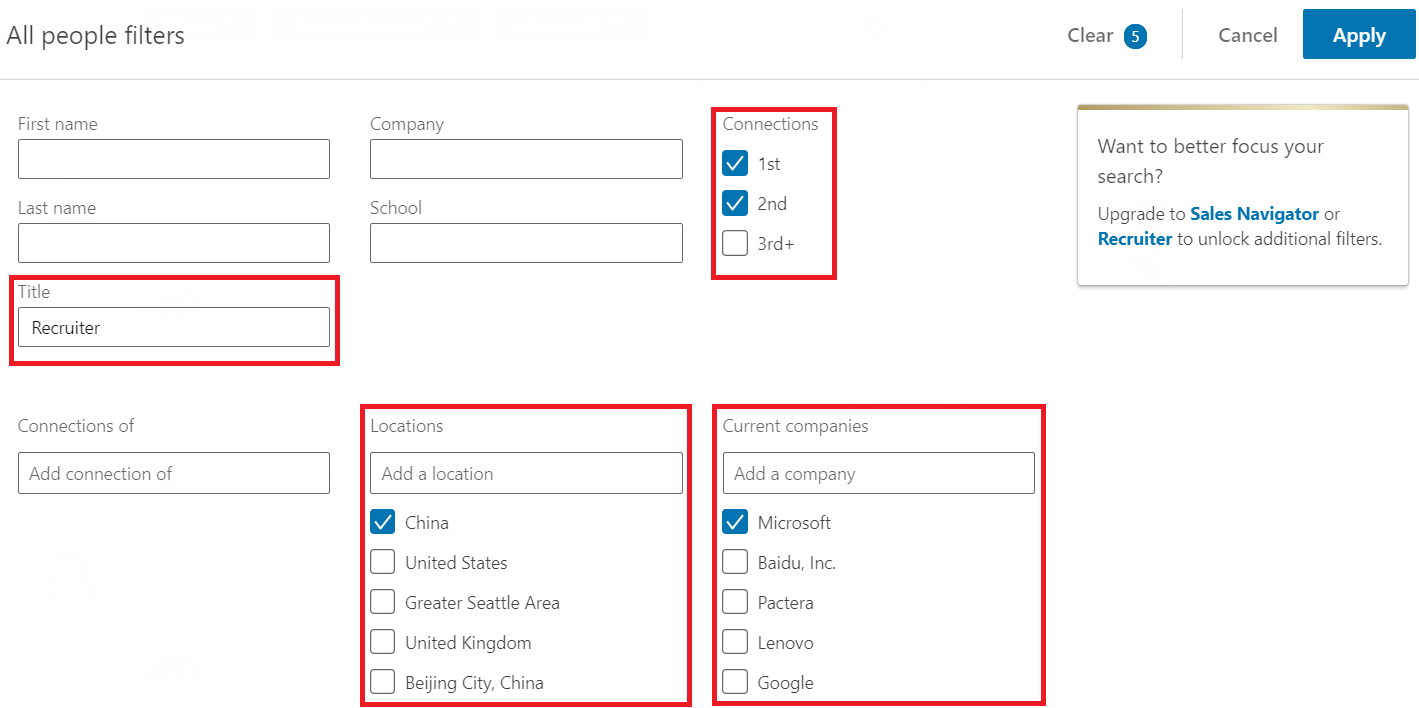
  6. Search smarter with Chinese and English keywords: Lastly, when searching for people to network with on LinkedIn, it’s a great idea to use keywords along with filters to refine your search. For example, if you are interested in connecting with people from Tencent in China, you can use the filters to narrow your search by company and country/region, and use keywords to locate people with the right type of role. Also, don’t forget that many potentially useful contacts may not speak much English or have parts of their profiles in Chinese. Therefore it’s also recommended to use a list of Chinese terms, such as 猎头 (recruiter), 社交媒体 (social media), or 通讯(telecommunications) to locate local Chinese contacts.

WeChat Networking Tips for China

WeChat is a vital app for everyday life in China. It’s also very useful for managing your China network, as while only more overseas oriented Chinese people will have LinkedIn accounts, it’s hard to find ANY Chinese person without a WeChat account.

  1. Choose a useful name: The first step to using WeChat successfully to help your career development is to have a profile name that not only lists an actual name (Chinese people often use anonymous names), and if possible lists your current company and profession (e.g., Chris Davis – Apple MKT). This will allow new contacts to easily find you in their contacts’ list and remember what you do.
  2. Fill in that summary: WeChat profiles also have their own short profile space. Use this as an opportunity to list key information you want others to know, such as your current goals, skills, and interests, especially as they relate to your career in China.
  3. Update contact “aliases”: When adding new contacts, first make sure to update your new friend’s “alias” to their actual name and position. Without an updated alias, all you’ll likely see in your contacts list are Chinese characters you either can’t read or can’t understand because they’re an anonymous identity. Having a clear idea of who each and every one of your WeChat contacts is will make managing your China network SO much easier.
  4. Make use of the “tag” option: Despite looking like a mere chat app to the untrained eye, WeChat is more than capable of acting as a hub for all your important China contacts. When adding a new contact, list them under several useful tags, such as company name and job (e.g., Sony), their job function (e.g., recruiter), and their relationship to you (e.g., close friend). This will make future networking much easier as you’ll be able to find needed contacts with just the press of a button.
  5. Create groups with similar interests: Like LinkedIn, WeChat also has a group function, though it is much more personal than that of its Western counterpart. Users are able to create their own groups and invite existing contacts. This allows you to form groups to pursue common interests (e.g., foreigners looking for work in China). Also, if you’re coming to China to develop your career, one of the more useful things you can do right off the bat is obtaining invites to existing groups and introducing yourself. This can quickly introduce you to people on the ground and gain you helpful contacts.
  6. Connect with colleagues: After figuring out the WeChat basics, make sure you start connecting with your colleagues at work, especially those in China where WeChat is essential. These contacts will form the beginnings of your network in China and will be able to provide useful help and support.
  7. Get on the recruiter grapevine: There are thousands upon thousands of Chinese recruiters on WeChat, always looking for new talent to recommend to companies. The key is getting their attention. In my experience, there are two key ways to do this. First, it’s common for people to recommend recruiters in their own network, so make sure to reach out to your own contacts (not in your department or team though) to ask if they can recommend one. Second, it’s common for recruiters to find talent via information posted on job search sites (especially Chinese ones). Therefore, if you’re looking for a job and want to get the attention of Chinese recruiters, find ways to post your resume online and include your phone/WeChat contact details. Based on what I’ve heard it’s possible to connect with several new recruiters each week using this method, assuming you stand out as a candidate.
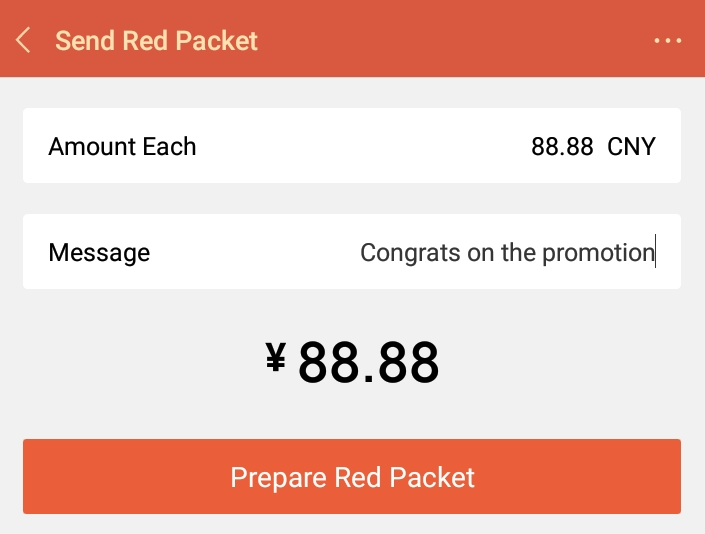
  8. Don’t forget those Red Envelopes: I introduced the concept of “Red Envelopes” in a previous article, and they are definitely an important part of maintaining a network in China. So, once you’re connected with potentially influential coworkers and friends, make sure to use Red Envelopes from to time to show your appreciation and celebrate important holidays and events.

Things to Remember

I’d like to emphasize that despite my own success using LinkedIn and WeChat in China, they are not necessarily the only ways to career networking success in the Middle Kingdom. Networking effectively will always be dependent on doing your research and making use of the available tools.

Use WeChat and LinkedIn to develop your career in China. Despite the importance of digital and online networking today, don’t forget that China IS a relationship-driven society. This means that while technology still plays an important role, often there is no replacing face-to-face networking, especially if you want to lay the foundations for strong and healthy relationships.

In closing, if you’re interested in working in China or with Chinese companies, there are still many great opportunities to be had. Just be aware that along with the developments in the Chinese market and society, demand for overseas talent is continuing to shift and evolve. To make the most of your search, make sure you make it your business to know what the local market is looking for, and who is looking. In this regard, LinkedIn and WeChat can be invaluable tools. Happy job hunting!

Thanks for reading!

Do you have any additional questions about using social networking to achieve career success in China? Do you have any suggestions on other sites or apps that can be used for job searching in China?  Please feel free to post your thoughts in the comments section. You can also send a send a message directly to the author on social media.

Follow the China Culture Corner to receive regular updates by email!