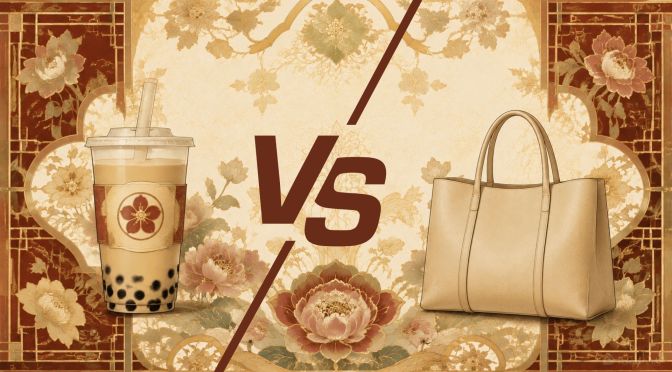
European luxury giant Louis Vuitton (LV) is losing a David vs. Goliath battle in a China trademark case, where the company already won its case in court but is losing public support after the case verdict went viral among China’s netizens.
The case revolves around Molly Tea, a local beverage brand founded in Shenzhen in 2021, built around jasmine milk tea and marketed as an aspirational brand centered on traditional Chinese cultural imagery. In just a few short years, the company has become a genuine success story, with 2,300+ stores in China and international locations across the US, UK, Canada, Australia, and Southeast Asia.
The problems with LV began when Molly Tea applied for trademark protection on its four-petal flower design, part of a broader brand identity built around simplifying Chinese cultural elements into geometric shapes.
China’s trademark office (CNIPA) rejected the applications. Following the rejection, Molly Tea still chose to use the design in its public marketing and advertising anyway. This led to the lawsuit, which was decided in LV’s favor: Molly Tea was fined $1.5 million (USD), ordered to stop using the contested design, and ordered to issue a public apology across all official channels.
But the real trouble for LV began only after they won in court.
What Really Got LV in Trouble in China
In the past six weeks since the Chinese court’s verdict was handed down, the case has gone viral on Chinese social media, with LV losing public support in China for several key reasons:
Cultural ownership: While LV’s brand story attributes the designs in question to Gothic and Japanese influences, many Chinese consumers instead traced those same designs back to Tang Dynasty art, part of China’s cultural heritage. This led to the image of a foreign luxury brand claiming exclusive commercial rights to aspects of the Chinese people’s shared cultural heritage, enough to leave a bad taste in many consumers’ mouths.
Power imbalance: LV vs Molly Tea was not a story of a Chinese company making inroads against LV in the luxury industry. To many Chinese netizens, it felt like a powerful European luxury conglomerate suing a smaller company that sold milk teas for $2.20.
A pattern of behavior: Over the past five years, LV has filed more than 1,700 trademark actions in China, largely against small shops, workshops, and local brands. In Chinese consumers’ minds, this made the story grow from one case against Molly Tea to the image of a global brand systematically attacking China’s street-level businesses.
Public humiliation: The final nail in the coffin for LV in the battle for public sentiment was the required public apology, which most sources agree must have been asked for by LV. For many in China, this went beyond a mere legal resolution into downright public humiliation, which is never a good look for an overseas brand in China given the country’s history with foreign powers from the mid-19th through the mid-20th century, a period still referenced today as the “century of humiliation.”
The thread that connects all these points is that LV had the law fully on its side in the Molly Tea case. Officially, they did nothing wrong. But they’re still losing where it counts.
The Problem Companies Make With Public Sentiment
The mistake many companies make is assuming everything can be resolved in the legal arena: Win a legal case? Great. Lose a case? Pay the fine and move on. But as we can see from the LV case, it’s rarely that simple.
I’ve seen this pattern time and again from inside the room where these decisions get made: companies focus on what works or makes sense legally and file legal cases without factoring in how consumers, media, partners, and other local stakeholders will react, and what biases they may develop.
The problem with legal first and public sentiment second, as we can see in the LV vs. Molly Tea case, is that while protecting IP can be very important to maintaining a strong brand in a new market, none of it matters if the consumers turn against you. No consumer trust equals no one to buy the brand you spent so much time and effort protecting.
If you’re interested in thoughtful perspectives on China, cross-border work, and how culture, incentives, and organizations shape real outcomes, you’re welcome to subscribe to China Culture Corner and receive future posts by email.
I also share related ideas and longer-form video commentary on LinkedIn and YouTube, and post updates across the channels linked above.
If you or your organization is navigating China execution or cross-border alignment challenges, I work with teams on an embedded and remote basis. Reach out directly: Sean@SageSightConsulting.com

