
In previous articles on the Chinese language, I have focused exclusively on Mandarin (also called pǔ tōng huà, literally the “common tongue”). Today, Mandarin is the official language of life and business across China, from Shenzhen in the humid south, to Harbin in the frigid north, to Lhasa in the arid west. But other prominent dialects also exist, the most widely spoken of which is Cantonese. To learn more about this widely spoken dialect, which is an important part of southern Chinese culture, I recently sat down to talk with my friend and fellow sinophile, Jeremy Ryder.
Jeremy is a native of Perth Australia, and originally became interested in China after living in a multicultural Asian environment (Chinese, Cantonese, Malay, Hakka, etc.) while attending university. He has lived all over China, though more recently he has made his home in the Guangdong province, where Cantonese originated. As a Chinese-English translation professional, Jeremy has devoted a large amount of his time over the last six years to studying Cantonese and southern Chinese culture.
China Culture Corner: What originally drew you to Cantonese?
Jeremy Ryder: The answer to this one goes back a long way. I had a life-changing period of about two years while attending Curtin University in Perth, where I found that all my flat mates spoke Chinese. Actually, only one of them was from China. The rest, along with their classmates and friends, were mainly ethnic Chinese from Malaysia, Singapore and Indonesia. During these two years, and in particular the last six months we spent together, I experienced something I had never known existed.
I became like a family member to these guys. After my classes, I would ride my bike home as fast as I could and I just couldn’t wait to arrive. As I rode closer to the flat, I could hear them all speaking in Mandarin and Cantonese, and when I heard it I just loved it so much. I couldn’t understand a word they were saying but I just loved being around them. They would only explain what they were saying to me occasionally in simple English, and would even sometimes laugh or gossip about me without me being any the wiser until they all started looking at me and laughing their heads off. They shared their culture, their food, their time and their stories with me, and we had the time of our lives. I also took them around Western Australia, showing them the pristine beaches and wineries that we have down there.
 Getting back to your question, the Cantonese seed was really planted in my heart early on. These guys took me to underground Hong Kong-style KTV places and Chinese clubs at two in the morning, places that no normal Australian would even know existed. I was exposed to the language when I couldn’t even differentiate between Cantonese and Mandarin. I had to keep asking them “are you guys speaking Cantonese or Mandarin?” After a while, I got used to who spoke what but one thing was for sure: I did not know then that I was going to study Chinese or Cantonese. I was 18 and I had no idea whatsoever what would happen next. I thought I’d simply get a job, get married and just have a simple life. But, I did say to myself, at least 20 times during my last six months with them, “Jeremy, your life will never ever be the same again.”
For some people, it’s hard to understand. Though my parents have been very supportive about the whole thing. I know when most Australians hear that I came to China to learn Chinese they think it’s strange and don’t understand why. In short, the experience I had during university was magical and special and I could honestly write an entire book about it, but that’s the best way I can explain the special passion that I have for the Cantonese language. So, it was natural that one day I had to start learning it.
China Culture Corner: You have just now referred to Cantonese as a “language”, while it’s much more common in English to refer to it as a “dialect.” What distinction do you make on this?
Jeremy Ryder: Many of my Cantonese textbooks refer to Cantonese as a language and Cantonese is the official language of Hong Kong and Macau. Interestingly, when you speak Cantonese, the local people in Guangdong, whose mother tongue is Cantonese, will tell you “wow, your Chinese is pretty good.” In other words, to them, Cantonese is the Chinese language. From my personal experience in Australia, when people refer to the Chinese language, a lot of people respond and ask “Do you mean Mandarin or Cantonese?”
When I was at IBM, and I did an interview to work on a project in Suzhou, one of the interview questions was “So you’ve got no problem communicating with the local staff in Suzhou, do you? Do they speak Mandarin or Cantonese?” That showed me that some foreigners are not sure about which languages are spoken in which parts of China. For me, I consider Cantonese as a language due to the large population of native speakers all over the world, and the widespread influence of Cantonese speakers throughout history.
China Culture Corner: How did you start studying Cantonese? What were your first steps?
 Jeremy Ryder: The first step was making a decision in my heart that “I am going to do this.” And not only that, but I had to reaffirm the decision and be sure about it. Having Cantonese idols, such as my favorite, Sammi Cheng, made it even easier to get motivated and follow my passion before starting this “marathon.” I also gave up Japanese, which I had been encouraged to learn previously at IBM Shanghai, to allow myself to commit to Cantonese fully. Next, I asked a school, where I went to previously for the HSK exam, to find me a VIP Cantonese teacher and give me 100 hours of lessons within two weeks.
I then took two weeks off work to start learning Cantonese. I had a wonderful teacher from Foshan who then went on to teach me every week after our first 100 hours for about a year. He was very patient and I looked after him by paying him well, focusing on my studies and taking him out for nice meals. Unfortunately, he later moved abroad to study Spanish so I then found two other teachers. I went to all the bookshops in Shanghai and Guangzhou and bought every book on Cantonese, but I could only find about 30 books. The best books were written in Chinese, not English, though later I found a great Cantonese-English dictionary which I studied – all 600 pages – in six months.
My teacher at the time told me “if you really want to study Cantonese, move to Guangzhou.” So I moved to Guangzhou, but I ended up living in the wrong part, the Tianhe district, where a lot of people spoke Mandarin. Later, I moved down to Foshan. In Foshan, I found that 99.9999% of the time the only thing I could hear around me was Cantonese, and I fell in love with the place. It’s not the kind of place, such as Beijing or Shanghai, where foreigners are popular or a novelty. It’s quite the opposite. If you walk along the street for an hour, nobody will look at you or acknowledge you at all. I found it to be a very traditional and conservative Chinese style. But Foshan, and in particular Shunde, has really maintained traditional Cantonese culture.
China Culture Corner: What were your key difficulties learning Cantonese? How is it different from Mandarin?
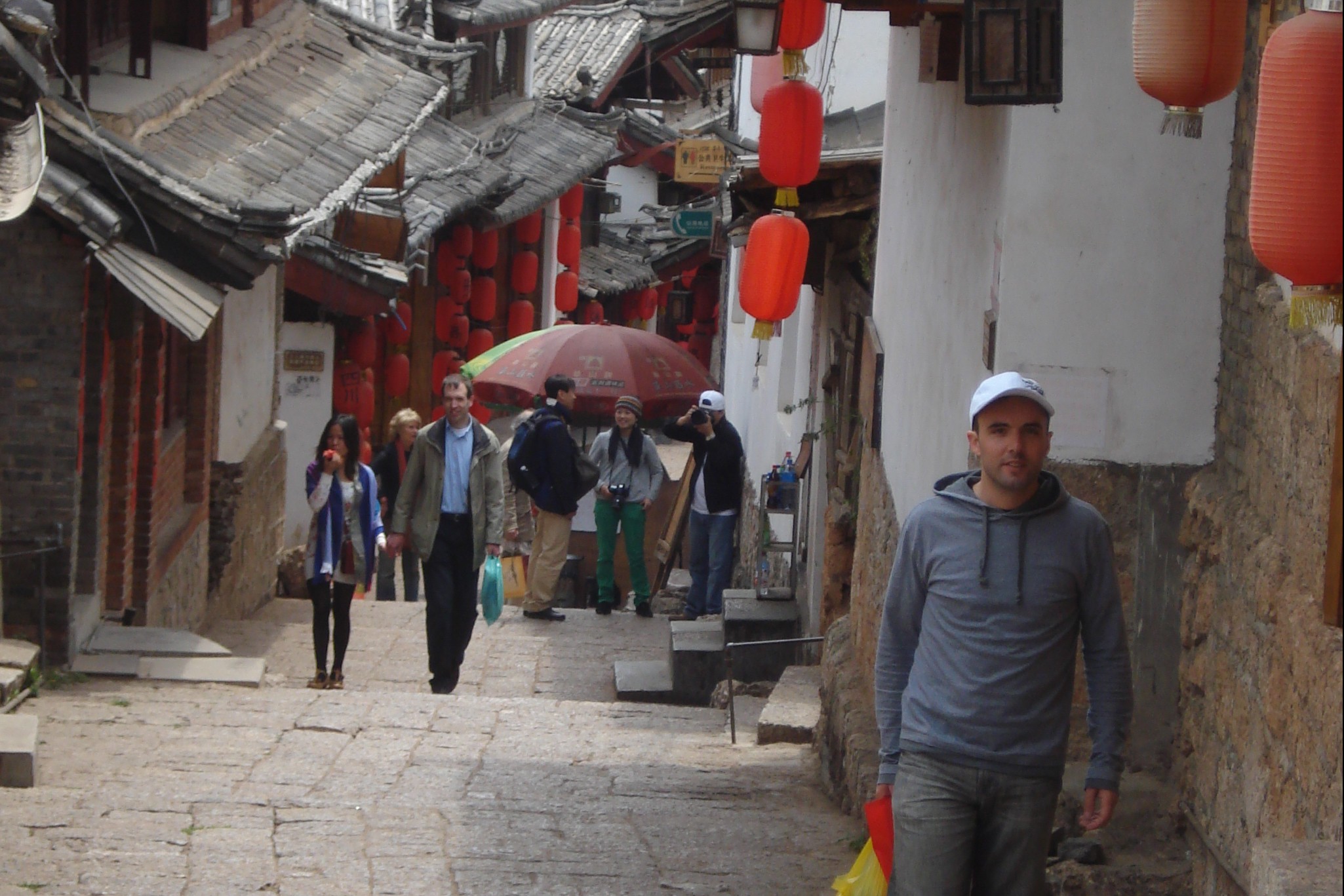 Jeremy Ryder: Cantonese is a very rich language, with more tones, making it harder to remember the correct pronunciation for each word. Cantonese is very colloquial and is constantly evolving. There are so many idioms and metaphors and there is so much slang to keep track of. The other thing is that there is a major lack of resources for studying Cantonese. Unless you’re competent and can sustain a decent conversation for a while, the Foshan guys will just slip back into Mandarin to overcome any communication or language barriers. That’s the danger.
Unfortunately I haven’t gotten good enough to have a decent conversation without the other person being reasonably patient with me, so even if you are immersed in a place where everyone is speaking Cantonese, you really have to keep learning, going to classes or watching all the Cantonese TV series to try to keep up with it. Moving to Shenzhen has almost killed it for me although they still have the Cantonese TV channels and some people who speak the language.
China Culture Corner: How useful can Cantonese truly be, when Mandarin is the national language?
Jeremy Ryder: I wouldn’t say that Cantonese should necessarily be the national language, but to me Cantonese is ”international Chinese” because ever since Cantonese spread all over the world hundreds of years ago during the gold rush, the language has spread and maintained itself with about 100 million speakers worldwide. In Australia, there are a lot of jobs advertised which require Cantonese. And, no matter where you are in the world, you will always be able to hear Cantonese. It has maintained itself internationally and throughout China, simply because of the number of Cantonese speakers and the fact that native Cantonese speakers know that their language really does have that edge and that power to it.
China Culture Corner: Recently, it’s been reported that many Chinese young people no longer speak the dialects of their parents, including Cantonese. What are your thoughts?
 Jeremy Ryder: This is the saddest thing and the worst possible scenario. When I grew up in Australia, I was friends with the one or two Chinese kids in my classes and I realized very quickly that none of them could speak Chinese or Cantonese at all. Even with surging numbers of Chinese people around the world, the language gets lost through the generations. I think it’s terrible because they’re losing something so valuable. Sure they want to integrate into the societies of Western countries, but I wish they knew how rich and valuable, in cultural terms, their language is.
The same thing is happening in cities in Guangdong province and in Shanghai: the young kids are getting worse at speaking their native dialects. Their parents are encouraging them to answer their phones in Mandarin, and even speak Mandarin to their own kids. This is cultural degradation and must be stopped. Conversely, at one point when there was a plan to exclude Cantonese from the media, the people in Guangzhou made a big fuss and fought to save their language. It really is important to the people in Guangzhou. Guangzhou is where Cantonese originated and is now being maintained, especially in Yuexiu and Liwan and other parts of the city. Of course, it’s not only about the language, but also maintaining other elements of the culture.
China Culture Corner: Do you have any advice for non-Chinese people who are interested in experiencing the Cantonese language and culture?
 Jeremy Ryder: Keep practicing on a daily basis. Don’t be afraid to speak out and look for opportunities in your life to use it. For example, talk to taxi drivers in Cantonese when you can. Use Cantonese in shops. Get a teacher and pay for classes. But above all, find something within the Cantonese culture that you are passionate about and keep coming back to it for motivation. For me, it’s listening to Cantonese songs that I like, but for others it could be watching TV series, watching movies, finding a Kungfu master to teach you Kungfu in Foshan or Hong Kong. Perhaps you like using Cantonese when shopping in Hong Kong.
It’s a hard language to learn and you’ll probably feel like giving up sometimes, but when that happens, go back to the source of your passion to “refuel.” Get motivated again and then keep going. Let go of western ideas or behaviors and keep an open mind about different aspects of Cantonese culture when you’re talking to the local people. Try not to think of yourself as an outsider in areas where Cantonese is the native tongue. Find as many different ways to learn as possible. Get into the food culture especially by going to the Yumcha restaurants or Cantonese restaurants and ordering in Cantonese.
Thanks for reading!
Do you have any questions about the Cantonese language or culture? Can you share your own experiences learning Cantonese? Please feel free to post your thoughts in the comments section below.
Follow the China Culture Corner to receive regular updates by email!






 The China Culture Corner